
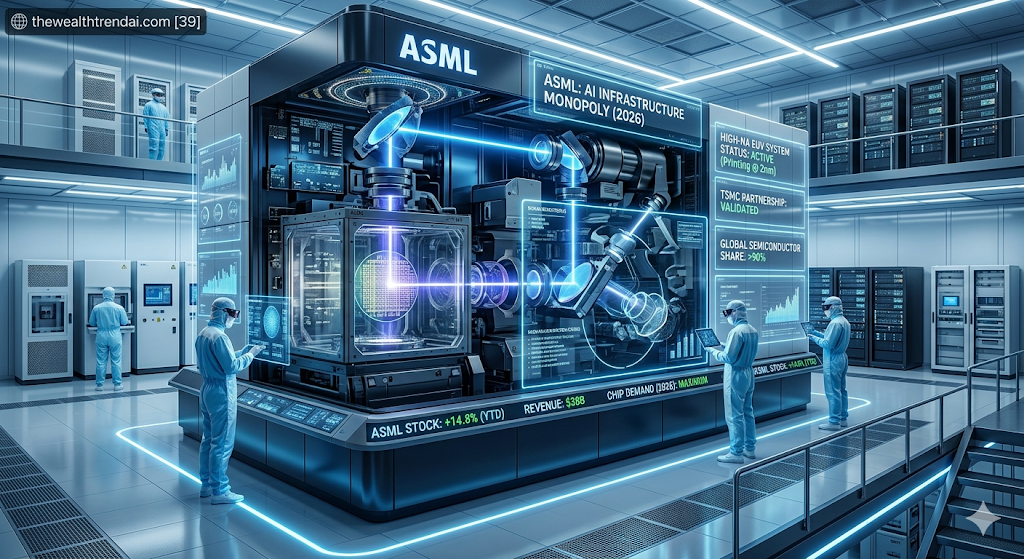
While the world focuses on AI software giants like OpenAI and chip designers like NVIDIA, the entire global tech economy relies on a single, indispensable gatekeeper: ASML. Based in the Netherlands, this company holds an absolute monopoly on Extreme Ultraviolet (EUV) lithography machines—the only tools capable of printing the microscopic transistors that power advanced AI hardware in 2026.
The $400 Million Machines Keeping the World Alive
In mid-2026, ASML’s latest High-NA EUV systems are the most complicated pieces of commercial machinery ever built by humanity. Costing over $400 million each, these machines use precise lasers to bounce light off mirrors, printing circuits just a few nanometers wide. Without ASML, TSMC cannot manufacture the chips, NVIDIA cannot design the GPUs, and tech giants cannot scale their artificial intelligence networks.
The Geopolitical Fortress of Wealth
For institutional investors in 2026, ASML is more than a tech stock; it is a sovereign geopolitical asset. The demand for these lithography systems vastly outstrips supply, creating an ironclad backlog of orders that guarantees revenue for the next decade. As countries like the US, Europe, and Japan scramble to build localized chip factories, ASML remains the sole beneficiary, collecting massive premiums regardless of which software company wins the AI race.
Conclusion
The true wealth of the AI revolution lies not in the applications we use, but in the physical infrastructure that creates them. ASML represents the ultimate monopoly in human history—a company that literally controls the physical limits of human computing power. For the strategic investor, this is the foundation upon which all modern digital wealth is constructed.