
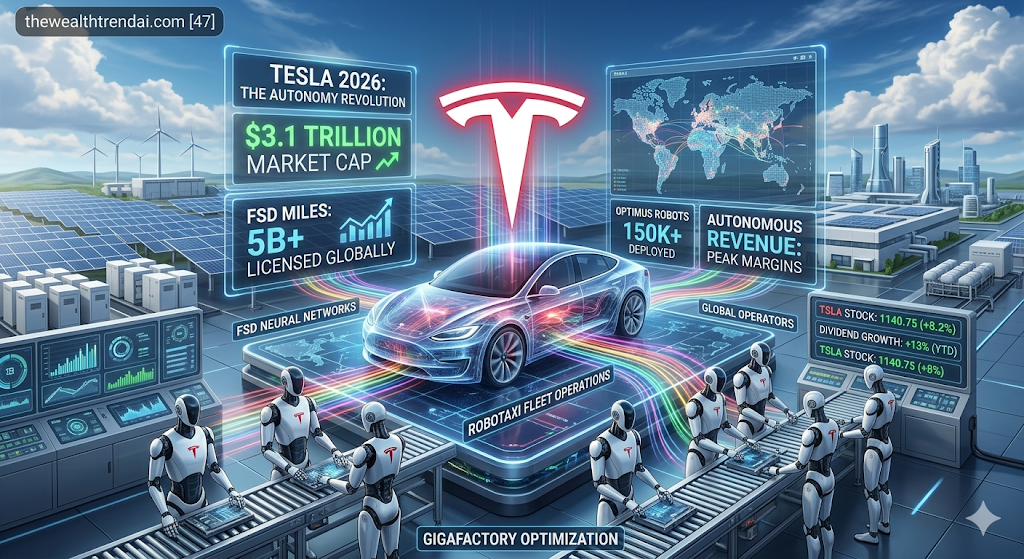
For years, traditional finance misclassified Tesla as merely an electric vehicle manufacturer. However, by mid-2026, Elon Musk’s enterprise has fundamentally rewritten global market dynamics. Through the aggressive commercialization of its Full Self-Driving (FSD) network and the deployment of autonomous humanoid robotics, Tesla has emerged as the world’s leading operational AI and robotics monopoly.
The Robotaxi Infrastructure and FSD Monopolization
The core value driver for Tesla in 2026 is its massive, high-margin software licensing ecosystem. Tesla’s vision-only FSD neural networks have achieved full regulatory approval across major global markets. Rather than relying solely on individual car sales, Tesla now operates a decentralized, autonomous Robotaxi fleet that generates continuous, high-margin recurring transaction fees, capturing immense wealth from traditional public transit and ride-sharing networks.
Optimus: The Automation of Physical Capital
Beyond autonomous transport, Tesla is building an unassailable industrial moat through its Optimus humanoid robotics program. In 2026, thousands of Optimus units are integrated into Tesla’s own Gigafactories, drastically reducing manufacturing overhead and optimizing production speed. By selling these advanced physical AI agents to external manufacturing and logistics enterprises globally, Tesla is capturing a brand-new, trillion-dollar industrial market.
Conclusion
Tesla’s strategic genius lies in its transition from low-margin hardware manufacturing to hyper-profitable AI and robotic automation platforms. By controlling both the physical machinery and the underlying neural networks that dictate autonomous motion, Tesla stands as a premier compounding asset for forward-thinking investors in 2026.